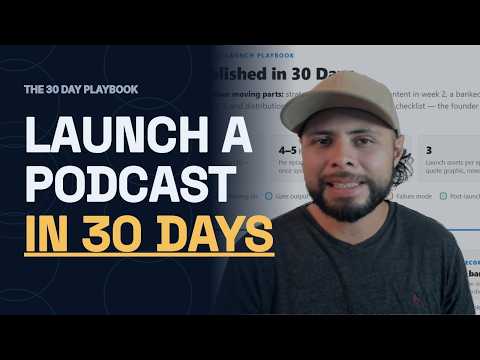
Most business podcasts fail by episode six, and it's not actually the content. It's usually that they don't have a plan or they don't have someone on the team that can actually execute plan. So, in the next few minutes, I'm going to give you the exact 30-day checklist that we use to launch every single one of our podcasts. And the good news is that if
you just have one competent person on your team, you can probably run the whole thing. Now, I want to tell you a quick story from my early days producing podcasts. I was talking to a business owner who had been successful in almost everything that they had done. Really successful salesperson, great in real
estate, and they thought that they were going to start and we laid out everything that they would take to do it. And I said, "Great, we'll do it on our own, you know, it seems easy enough." And I said, "Amazing, you know, good luck. Let me know if you have any questions." Well, I actually checked back in with that same business owner about 6 months later and saw on their website that it podcast still said that it was coming soon. And when I had and
talked to them, they said that they had ran into difficulties and sort of put the podcast on the shelf. And what it really came down to is that it became too much and there were too many things to do in order to actually get it actually launched and off the ground. Now, that happens more often than not,
and there are thousands, maybe millions of podcasts in the podcast graveyard of those that never got past episode seven. But there are even more that never actually got their first episode launched. And so, if you are considering starting a podcast or you're thinking about starting one for your business, this video is going to be critical for your success. Now, if you're a CMO, your
head of marketing, or you're somebody who is in an organization and someone came to you and said, "Hey, we need to start a podcast." This video is for you. Or if you are a business owner and the host and you're going to be doing everything yourself, this video is even more important for you. And the reason
is is that because the podcast game has changed, technology has changed, AI has changed, and almost all of the advice that was relevant and helpful 5, 10 years ago is almost completely irrelevant. The platforms have changed, YouTube is more important, Spotify is a player, and so this video is going to help you know exactly what to do in order to succeed in today's landscape.
Now, if you don't know who I am, my name is Hector Santi Estepon, and I've spent much of the last decade producing, publishing, marketing, and creating podcasts for businesses to help them grow their revenue. We've launched dozens of shows, produced thousands of episodes, and generated millions of downloads, but most importantly that has contributed to millions of dollars in revenue for businesses just like yours.
Now, let's get into it. You'll see here that on the screen we have a a blueprint to launching a podcast in 30 days. And of course, you can do it in 30 days or you can stretch it out to whatever makes the most sense. I have a lot of people who will come to me and ask how quickly can we get a podcast out? And it's
really the answer is how quickly you want to get through and move through this process. And so, I think before we get into that, it probably helps to go into why launches die. And I think that there's there's two there's sort of two problems that kind of emerge here. The first is complexity. As we go
through it, you'll see there are a lot of different things that happen and a lot of different things that go on in the launch, and there's a lot of different skill sets that are required. You know, there always graphic design and video editing and audio editing and SEO and writing and there's all these different things, administrative, uploading, technical, you know, CMS management. There's all these things
that need to happen in order for it to go. Uh the good news is that with a lot of AI tools and a lot of the technology that's emerged, if you have somebody who is competent or if you are the competent person on the team, you can get it done. It might take you a little bit to figure
out what goes where and how to do all of the things that are necessary, but it is possible. Uh the second thing that happens is that people run out of content. It's very easy for a business owner, especially a busy executive, to find lots of other things other than recording content. And so, we have a
couple of things which we'll get into and a lot of reasons for a lot of a couple of methods that help with that, but that is a a big thing to consider when you're starting is that I would either wait until you can commit to recording consistently or wait until you have enough recordings recorded in order to launch. And I think another
thing that people ask me often is what's the minimum or what should I expect when I'm getting into it? And so, when I think about what is the minimum viable launch or what are the sort of basics that you should look to shoot for. Um there are a couple of them sort of standards that we try to meet. The first
is to have at least five episodes recorded and it part of the reason and a big reason is what I just talked about and that's that people run out really quickly. Even with those five episodes, if you're doing one episode a week after you launch um by the next month, you're going to need to record again. And so
unless you have a plan in place, unless you have something um that is going to consistently feed that content runway, uh it's going to be very challenging for the show to be successful. The second thing that we try and give people the right sort of expectation about is generally takes about 4 to 5 hours per episode at the beginning. That doesn't
have to stay that way. You can get that down to 1 to 2 hours including the recording, including the prep, and the editing, and the publishing. All that sort of stuff can get cut down to 1 to 2 hours a week or 1 to 2 hours per episode. But at the beginning when you're figuring out what goes where and where things are, uh it's going to take a little bit longer. And so it's good to
just have that expectation. Another expectation that or another thing that you should just prepare for or just be ready for is that by just by publishing your show on Spotify or on Apple or even putting it on YouTube does not necessarily mean that someone is going to see it. It definitely doesn't
mean that anybody's going to watch it or listen to it. And it definitely doesn't mean that anybody's going to care about it. And so having a way to share your show, whether that be on, you know, LinkedIn or social media or emails or even if that's through your own personal connections and, you know, IRL, you know, events and things like that, having some sort of strategy in order to tell people about your show is going to be critical for you to be successful.
Critical to you being successful. And the last sort of benchmark here that we try and have people, you know, have a expectation for is looking to put out an episode at least every other week. And this one says 24. Probably a better number to have on here is 25. There's some statistics where it's basically you
are in the top 1% of shows if you get to the 25th episode. That's because most shows will quit after seven. Uh even less will get to 10. But 25 really allows you to get into some rhythm, allows you to figure some things out, and usually by then people are starting to see some of the benefits that have come from it. And we like to think about
a podcast as like at least a year-long project, right? Give it a year and you will definitely be able to see some of the benefits from the visibility and the awareness, and if you do things right, you can start to generate clients directly from it. But having this perspective will help you
deal with some of the challenges of the frustration, or even give you a little bit more patience as things are getting going because again, this is a a process that takes time. All right, so let's get into the individual weeks. And we once again, we broke them into weeks here. You can break them into months, you can
break them into phases. Can this be done in a month? It could be done in a quarter. I mean, we've even launched shows in less than a week. Really what it is is we try and do the things at the beginning that allow everything downstream of that to be much more efficient, much more effective, and so that you're not having to figure things out after the fact, or you're not going back and redoing things. And so the
first thing that um we helped to nail down whether we're launching a show or that we encourage people to do when we're working with them is to figure out their what we call the three P's, and that's their their premise, their positioning, and the purpose of the show. And then the premise is
essentially, you know, what is the show about? In in a in an essence, what is it about? And the way that I can sort of explain it, the way that I like to explain it is if someone had no idea who you are, why would they still want to listen to the show? What can you create a show about that regardless if someone has a connection with you, or regardless if someone has a relationship with you, that they would still be interested in it because they're either interested in the topic, or they're interested in the industry, or there's something about what's happening on the show that is going to interest them regardless of who's actually hosting it. But if you do
that, right, you'll start to attract people that are both in your network and outside of your network, and it allows you to do the second part, which is position yourself the right way because I've seen so many people who start shows and they're 25 episodes in, 50 episodes in, and they're they're years into this project, and they look up and they realize that nothing's actually happening from it. People aren't coming
into their business from them, and they and they feel like they're not getting what they thought they'd get out of it. And a big reason for that is because they're not positioning themselves in the right way. And the best way that I can think of this is like how do you want the listener to think about you with regards to what it is that you do.
What parking space what bucket do you want them to put you in? And it's important to do that from the get-go. So that way when someone has the opportunity to go deeper and spend time going down your rabbit hole and listening to three, five, 10 episodes, all of the sudden they come out in your position in the way that's going to help for your sales process. And so again,
thinking through that at the beginning is going to be really helpful in doing all the rest of the stuff that we're going to talk about. Okay. The last part for this initial section is the purpose of the show. Now this may sound simple, but again, I've seen and I've met with a number of businesses who have gotten well into this project and haven't actually figured out what the show is going to do for their business.
Because are they using it to get clients? You can use it to get clients directly. You can use it as part of your sales process. But how is it going to fit into what you are actually doing for the business? Is it there to build your network? Is it there to highlight your network? Are you using it as a way to
get your foot in the door with potential prospects or partners or people in the industry that can get you more opportunities such as speaking gigs or industry orgs. And so building your network is obviously one path and one reason for having the show. Or you might want to use it to leverage and build
your authority. And we work with a lot of businesses who have been doing what they're doing for years and decades. And oftentimes they started their business and really got going well before the social media age. And so a lot of their credibility, a lot of their success isn't necessarily put in anything digital. And so this actually creates a
great opportunity for them to a either highlight those people, share those stories, more importantly share the experience and share the perspectives and the things that they've gained along the way that sets them apart from everybody else in their field. But regardless, picking one of these three
things is going to help create results faster than if you're just starting a show and winging it. Once that's out in, the second thing that we're going to dial in is the branding. Both from a visual aspect and also from an audio aspect. You want to make sure that you have a something that
both looks and sounds cohesive. The The best example I can give is like a restaurant. You have probably been to restaurants where you walk in and the ambience is great, the music's great, the lighting is great, the service is great, the food is great, right? And so both of these in conjunction are working
together to create this experience. You probably had a experience where there's great food, but the service is terrible, or great food, but you know, it's not the best environment, not the best atmosphere. And so thinking through both of these things, you might have great content, you might have a great perspective, but if you don't have the packaging, it's not going to be able to reach as many people as if you think through this and your branding, both from a visual and from an audio perspective, is dialed in. And so there
are a couple of things that you want to make sure you have, that your cover art and your thumbnails for YouTube, um maybe you're thinking about your lower thirds for your videos, uh also your jingles and your music, all of that stuff creates this experience for listeners, so that when they ultimately do interact with you, whether it's on a Zoom or in person, there's this relationship and this connection that's already been developed. Another thing
that's important to decide at this stage is your episode formats. And one of the things that you just want to think through before you start recording is how are we going to convey this information? Do we want to be sharing frameworks and different things that we're doing? Do we want to be
interviewing clients, prospective partners? Do we want to be sharing case studies of success stories? Or do we want to just be doing solo episodes where we're sharing our processes, sharing our perspectives, and handling objections along the way? One of the great use cases for a podcast is in the
sales process. What we find in B2B sales and and you know, all a lot of sales, uh there are specific objections that clients are running into often. And so if there is a specific thing or specific issue that your customers are running into consistently, you can record a piece of content and then you can send them that when they're experiencing that or when they have that issue or when that question comes up. But even
more often, what will happen is they'll listen to that and they'll consume that before the sales call uh in anticipation of it, and so they come in and those those objections don't even come up. And so thinking through this is really going to allow you when you get into the next part, which is actually the recording, right? And we we say build the bank.
There are a couple things that you probably want to think through, you know, making sure that you have a good decent camera, a good microphone. It's it's probably worthwhile to invest into a decent microphone. Most of the webcams will be good enough, but a good microphone goes a really long way. And a
lot of business are realizing that there's a lot of value in utilizing and leveraging something like a studio. There's a very affordable studios that you can rent out for an interview or two. And what it does is it also gives you an opportunity to connect with these people in person and connect with these guests in an in-person setting, which just goes a little bit deeper than a Zoom recording would, right? Either way,
you want to get them done. We recommend one of two things when we are getting our initial recordings. The first thing is a batch recording. And so, we'll have some clients that will record all of their content, you know, once a month they'll record all of the content for the month or once a quarter even. Um they'll they'll sit down for an
afternoon or a day or even, you know, a couple of days and just dedicate all of their focus to pumping out the content, so that way they don't have to look up and and worry about it again for another month or another couple of months. On the other end of the spectrum, we have some people that they would much rather have sort of a standing recording time.
A lot of executives, they have standing meetings, whether it's other partners or with other people on the team. And so, having that standing recording time, whether it's every Wednesday afternoon or every Friday afternoon or whatever it is, allows them to mentally prepare, it allows them to have things ready, and it creates this sort of habit that uh you know, goes a really long way for an executive in creating this sort of consistency. But again,
once you have the recording, uh a lot of that stuff is really downhill from there. And so, when we're launching, we like to to have five recorded no matter what, um just because again, that's going to give us a little bit of breathing room. Uh if we can have 10 in the bank, we feel even
better about that. And then anything on top of that is just extra and bonus. The last part is setting up our platform and preparing to publish and launch. And what's nice about this is that it's gotten much simpler over the last several years in order to do that. Our hosting provider that we like to
recommend is Captivate and one of the reasons is because once you are on them, you upload your your podcast and you click one button and it goes out to all the different places that it needs to go to. It goes to Spotify, it goes to Apple, it goes to Amazon Music, goes to Stitcher, or all you know, everywhere that podcasts are found, Captivate sends it out there and makes it much easier for you to do so.
Once you've done that, you're ready to go. We like to launch with at least one episode and a trailer. If you launch with a couple more, it's going to make it even easier. So, after that, you're ready to go. If you want access to this blueprint, just leave a comment blueprint and we'll send this to you. And if you have any questions, feel
free to let me know. We'll see you on the next one.

 3:49